
Search Minnesota Deed Records
Minnesota deed records are public documents held at the county level. Each of the state's 87 counties keeps its own property records through the County Recorder or Registrar of Titles. You can search deed records to find out who owns a property, review past transfers, check for liens, or trace the history of a parcel. Most counties now offer online tools, and many records go back over a hundred years. This guide explains how the system works, what to look for, and where to go in Minnesota to find deed records for any property.
Minnesota Deed Records Overview
Minnesota's Deed Recording System
Minnesota does not have a statewide deed records portal. All property deed records are held at the county level. Each of the 87 counties maintains its own recording system through the County Recorder's Office or Registrar of Titles. When a property changes hands, the deed must be recorded in the county where the land sits. This is the only way the transfer becomes official and protected under state law.
The state runs two parallel recording systems. The first is the Abstract system, where the County Recorder files and indexes all deed documents. Title to the property is traced through a chain of documents in the abstract. The second is the Torrens system, governed by Minnesota Statutes Chapter 508, which is a court-based registration system. Under Torrens, a Certificate of Title is issued and backed by the state. Some counties also handle Certificate of Possessory Title (CPT) registrations under Chapter 508A, which allows administrative registration without a court proceeding. Knowing which system applies to a parcel matters because the search process differs between them.
Under Minnesota Statute 507.34, every conveyance of real estate must be recorded with the county recorder where the land is located. Any deed not recorded is void against a later buyer in good faith who records first. This is why recording promptly after closing protects the new owner's interest.
The Minnesota Geospatial Information Office (MnGeo) maintains links to county parcel data sources statewide. They note that parcel boundary data is held at the county level by the recorder's, assessor's, or land surveyor's offices. MnGeo does not run a central deed database, but their Land Ownership Information page is a useful starting point for finding which county system to use.
The screenshot below shows the MnGeo land ownership information portal, which links to parcel data across all Minnesota counties.
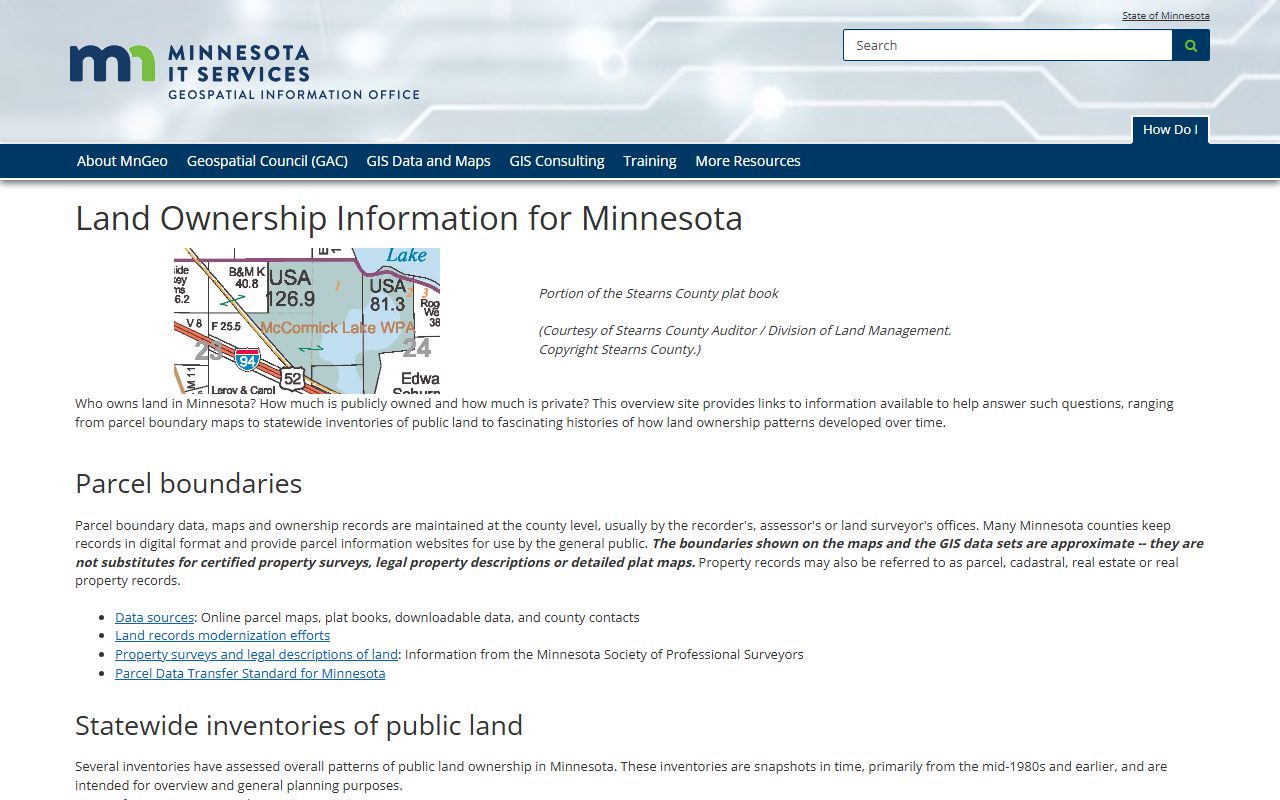
MnGeo's land ownership page connects researchers to county parcel records and GIS mapping tools across the state.
How to Search Deed Records in Minnesota
The first step is to identify the county where the property sits. Once you know the county, you go directly to that county's recorder website or office. There is no single search tool that covers all 87 counties. Each county sets up its own system, and access varies widely from full online search to in-person only.
Many Minnesota counties have adopted one of several common online platforms. RecordEASE is used in Hennepin, Ramsey, Dakota, Scott, and Sherburne counties, among others. LandShark serves Olmsted, Wright, Rice, Todd, and Renville counties. Beacon is available for Blue Earth, Rice, and Sherburne counties. Tapestry and Laredo are used in Steele and Stevens counties. Some platforms charge per search or document, while others offer monthly subscriptions. Pope County offers free access to historical tract indexes through ArcaSearch. Fillmore County also uses ArcaSearch for records dating from 1853 to 1963, and iDocMarket for documents from 1964 forward.
For in-person searches, go to the County Recorder's Office during business hours. Most offices are open Monday through Friday from 8 a.m. to 4:30 p.m. Bring the parcel ID, legal description, or property address. Staff can pull up the abstract or certificate of title and make copies. Certified copies cost $10 per document at most offices. Plain copies run about $1 per page. Some counties charge a well disclosure certificate fee of $54 when a deed is recorded involving a property with a well.
Note: Parcel map boundaries shown in online GIS tools are approximate. They are not substitutes for a certified survey when exact boundary locations matter.
The screenshot below shows the Minnesota Revisor of Statutes website, the official source for state laws governing deed records and property transfers.
The Minnesota Revisor of Statutes site at revisor.mn.gov is the authoritative source for all statutes governing deed recording and property transfers.
Minnesota Deed Recording Requirements
All documents submitted for recording must meet the standards set in Minnesota Statute 507.093. The rules cover paper size, ink color, font size, and how the first page must be formatted. Documents that do not meet these standards can be rejected at the recorder's counter.
The basic document requirements are:
- Maximum sheet size of 8.5 inches by 14 inches
- Printed in black ink, minimum 8-point type
- White paper, not less than 20-pound weight
- First page must have a 3-inch blank space at the top for recording information and tax certification
- Title of the document displayed prominently at the top of the first page
- Must be legible enough to produce a readable photocopy
- No correction fluid (white-out) allowed on any document
Under Minnesota Statute 507.24, a document must be executed and acknowledged before it can be recorded. Original signatures are required unless the document qualifies for electronic recording. If a deed is signed outside Minnesota, it must meet either Minnesota's requirements or the legal requirements of the state where it was signed. Electronic recording is available in many counties and must conform to standards set by the Electronic Real Estate Recording Commission.
Married owners who are conveying a homestead must have both spouses sign, as required under Minnesota Statute 507.02. There are exceptions for purchase money mortgages and conveyances between spouses. Either spouse may appoint an attorney-in-fact for non-homestead property transactions.
The screenshot below shows the Minnesota Department of Revenue site, which administers the deed tax that applies to most property transfers in the state.
The Minnesota Department of Revenue site provides information on the deed tax, mortgage registry tax, and how these apply to recorded property documents.
Minnesota Deed Tax and Recording Fees
Most property transfers in Minnesota are subject to the deed tax under Minnesota Statute 287.21. The standard rate is 0.33% of the net consideration when the sale price exceeds $3,000. For sales of $3,000 or less, the flat tax is $1.65. Hennepin and Ramsey counties apply a slightly higher rate of 0.34%. The deed tax is due at the time the deed is presented for recording. The county auditor must certify payment of all delinquent property taxes before the recorder can accept the deed for filing, as required by Minnesota Statute 272.12.
The standard recording fee across most Minnesota counties is $46 per document. This applies to deeds, mortgages, satisfactions, and most other real estate instruments. Plat recording costs $56. A well disclosure certificate costs $54 when required. Certified copies of recorded documents are $10 each. Photocopies are typically $0.25 to $1 per page depending on the county. Separate fee schedules apply to Torrens documents in some counties.
Some transfers are exempt from the deed tax. Exemptions include decrees of marriage dissolution, transfers between spouses, conveyances to federal or state government, certain agricultural mortgages, and low-income housing program transfers. Details on exemptions are in Minnesota Statute 287.04. Mortgages are subject to a separate mortgage registry tax of 0.23% of the debt secured, with a minimum of $1.65.
Types of Deed Records in Minnesota
Minnesota recorders handle many types of real estate documents. The two most common deeds are the warranty deed and the quitclaim deed, both defined in Minnesota Statute 507.07. A warranty deed includes covenants from the seller guaranteeing title. A quitclaim deed conveys whatever interest the grantor has without any warranty. Both must be executed, acknowledged, and recorded to be effective against later purchasers.
Transfer on Death Deeds (TODDs) are another common instrument governed by Minnesota Statute 507.071. A TODD lets a property owner name a beneficiary to receive the property at death without going through probate. The deed must be recorded before the grantor dies to be valid. It can be revoked at any time. TODDs are subject to existing liens and encumbrances. Dakota County notes that TODDs are not accepted at service centers and must be mailed or dropped off at the main office in Hastings.
Contracts for deed are also recorded. Under Minnesota Statute 507.235, any contract for deed signed on or after January 1, 1984, must be recorded within four months. The vendor must deliver a recordable copy to the buyer and pay any delinquent taxes needed for recordation. Failure to file carries a penalty of 2% of the principal amount of the contract debt. The recorder keeps contracts for deed in the same index as other real estate documents.
Mortgages, mortgage satisfactions, and discharge certificates are also part of the deed records system. A mortgage is discharged when the mortgagee files a certificate of satisfaction under Minnesota Statute 507.40. The discharge is then entered in the reception book and indexes at the recorder's office. Recorded foreclosure documents and sheriff's certificates of sale are also part of the public deed records. Foreclosure by advertisement is governed by Minnesota Statute Chapter 580.
The screenshot below shows the Minnesota Attorney General's website, which has resources on property consumer protection including contract for deed and home improvement issues.

The Minnesota Attorney General actively investigates predatory contract-for-deed practices and provides consumer resources for property owners at ag.state.mn.us.
Property Fraud Protection
Several Minnesota counties offer free Property Watch alert services. These programs notify property owners by email when a document is recorded against their parcel. Aitkin County runs its alert service at propertyrecords.co.aitkin.mn.us. Cottonwood County, Scott County, Sherburne County, Wabasha County, and Wadena County also offer free monitoring. Rice County has a similar service at its Land Notifications page. Renville County provides land notification alerts tied to its LandShark system. These tools help owners catch unauthorized transfers or fraudulent liens early.
The Minnesota Judicial Branch also keeps court records that affect property. Judgments entered against a property owner can become liens on real estate. The Minnesota Courts website at mncourts.gov gives access to court case records, including foreclosure cases and lis pendens notices that affect title. Property buyers and lenders often search both deed records and court records before closing.
The screenshot below shows the Minnesota Judicial Branch website, which maintains court records that can affect property title, including judgments and foreclosure cases.
The Minnesota Courts site at mncourts.gov provides access to court records that affect real property, including foreclosure filings, judgments, and lis pendens.
GIS Mapping and Parcel Data
Most Minnesota counties maintain online GIS mapping systems that show parcel boundaries, ownership names, and property values. These tools are often free to use and can help you identify a parcel ID before heading to the recorder's office. Hennepin County's interactive GIS property map lets you search by address or 13-digit parcel ID and shows whether a parcel is Abstract or Torrens. Crow Wing County offers its own property search at propertyinformation.crowwing.gov. Aitkin County runs a GIS viewer at gisweb.aitkincountymn.gov.
The MnGeo office compiles statewide parcel data for counties that opt in to sharing. That dataset is at gisdata.mn.gov but only includes participating counties. For full coverage, you still need to check each county's own tools. The screenshot below shows the MnGeo Geospatial Information Office site, which serves as the hub for Minnesota land ownership and parcel information across all 87 counties.
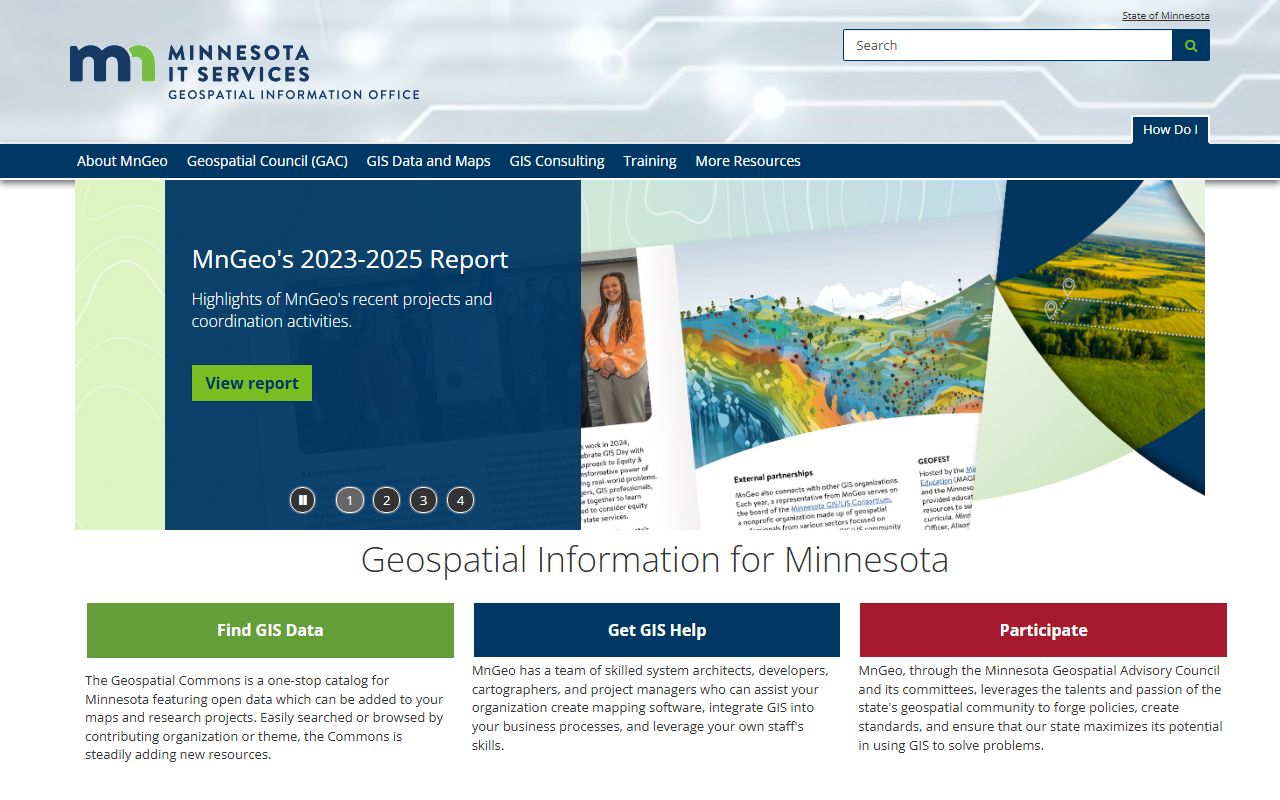
MnGeo at mngeo.state.mn.us links to county parcel data sources across Minnesota and provides a statewide inventory of land ownership information.
Real Estate Closings and Deed Recording
Under Minnesota Statute 507.45, residential real estate closings can be handled by a licensed attorney, real estate broker, salesperson, or closing agent. The closer must disclose their fee at least five business days before closing. No party can require the buyer or seller to use a specific closer. Title insurance or a legal opinion is required for any closing involving a fee. After closing, the deed and any mortgage are sent to the county recorder for filing. The recorder time-stamps each document and assigns a reception number. That number goes into the official index.
Common Interest Communities, including condos and townhomes, have their own layer of recorded documents under Minnesota Statute Chapter 515B. Declarations, bylaws, and amendments to the common interest community documents are recorded with the county recorder. Buyers of units in these developments should search for the recorded declaration and any recorded amendments before purchase. Association assessment liens can also be recorded against individual units.
The Secretary of State maintains a separate portal at mblsportal.sos.state.mn.gov for UCC filings, business entity searches, and tax lien records. The Secretary of State does not hold real property deed records. Those stay at the county level.
Browse Minnesota Deed Records by County
Deed records in Minnesota are held county by county. Pick a county below to find the local recorder's office, online search tools, and contact information.
View All 87 Minnesota Counties
Deed Records in Major Minnesota Cities
Deed records for city properties are filed at the county recorder serving that city. Select a city below for local resources and search options.