
Morrison County Deed Records Search
Morrison County deed records document every property sale, mortgage, and land conveyance recorded in this central Minnesota county along the Mississippi River. The Recorder's Office in Little Falls maintains these records and provides LandShark online access so anyone can search deeds, view document images, and trace ownership history without coming to the courthouse.
Morrison County Deed Records Overview
Morrison County Recorder's Office
The Morrison County Recorder's Office in Little Falls records all deeds, mortgages, liens, easements, plats, and other instruments affecting real property in the county. The office maintains the official index and provides both online access through LandShark and in-person service at the courthouse.
The Recorder's main number is 320-632-0146. The county website at co.morrison.mn.us has current hours, office address, and links to LandShark and other county resources. Staff can assist with document submission, copies, and research questions.
Morrison County uses both abstract and Torrens title systems. Abstract title is most common for rural and agricultural land. Some properties in Little Falls and incorporated towns use Torrens registration. If you are not sure which system applies to a parcel, the Recorder's Office can confirm this when you call.
The Morrison County website provides a central hub for accessing recorder services and navigating to the LandShark portal.
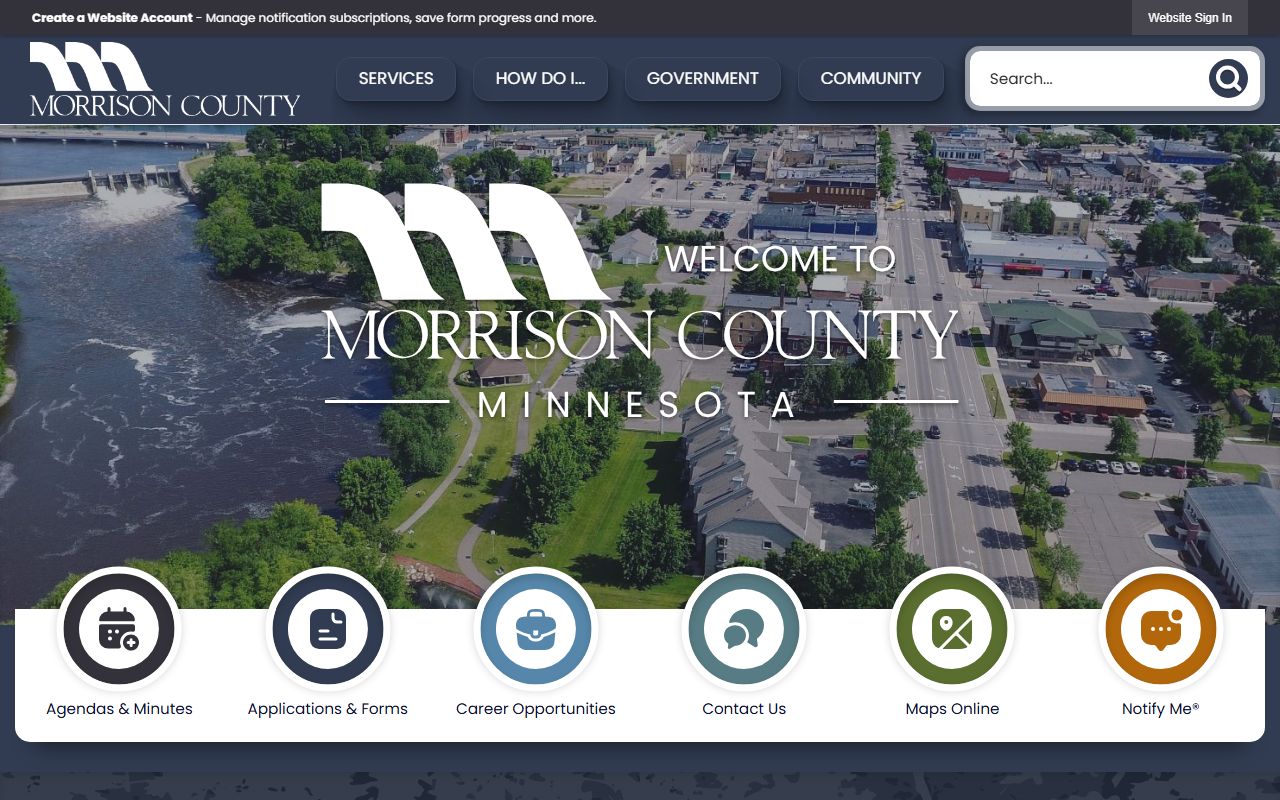
From the county homepage, you can find links to property search tools, recorder forms, and office contact information.
Searching Morrison County Deed Records
Morrison County uses LandShark for online deed record searches. LandShark is a document management platform widely used by Minnesota counties that lets you search by grantor name, grantee name, document type, date range, or legal description. Searching is free, and document images are available for a small fee per page.
LandShark is especially useful for title research because you can trace a property through grantor and grantee indexes without manually pulling physical books. You can search forward in time using grantee indexes and backward using grantor indexes to build a chain of title.
For documents not available in LandShark, contact the Recorder's Office directly. Staff can search older records not yet digitized and provide copies for research or legal purposes. Calling ahead with the legal description or parcel ID helps staff locate the right documents.
Under Minnesota Statute 507.34, recording a deed provides legal notice to all future buyers and lenders. Checking the Morrison County records before a real estate closing is essential to confirm no prior unrecorded claims exist.
LandShark Online Access
LandShark provides access to Morrison County deed records around the clock. The system covers warranty deeds, quitclaim deeds, mortgages, satisfaction of mortgage, mechanic's liens, sheriff's certificates, plats, and more. The index goes back many years and is searchable by multiple fields.
Document images in LandShark are typically available for a per-page fee. You can view thumbnails at no charge to confirm you have the right document, then purchase the full image if needed. For high-volume users like title companies, subscription accounts are available through the LandShark platform.
The Minnesota Geospatial Information Office at mngeo.state.mn.us offers supplemental land ownership data for Morrison County that can be used alongside LandShark searches.
Attorneys and surveyors doing detailed boundary or easement research sometimes pair LandShark document access with the county GIS data to get both document-level and spatial information about a parcel.
Recording Fees and Requirements
The base recording fee in Morrison County is $46 for the first page of any deed. Multi-page documents cost more. The fee schedule follows Minnesota state law.
Deed tax is a separate cost under Minnesota Statute 287.21. The tax is 0.33% of the purchase price (net consideration). On a $180,000 sale, the deed tax totals $594. Certain transfers are exempt, such as gifts, family conveyances, and government transfers. The county auditor must stamp the deed to confirm deed tax payment before the Recorder will accept it.
Documents must meet physical standards under Minnesota Statute 507.093. Key requirements include a 3-inch blank margin at the top of the first page, legible printing, and a return address for the recorded instrument. Documents that fail these standards may be returned or charged a non-conforming document surcharge.
Contact the Recorder at 320-632-0146 with fee questions before mailing documents. Payment is typically accepted by check made payable to Morrison County.
Types of Deeds in Morrison County
Morrison County records several types of deeds. Each serves a different purpose and offers a different level of protection to the buyer.
A warranty deed is the most buyer-friendly option. The seller promises the title is good and will defend any future claims. Most market sales use this deed type. Under Minnesota Statute 507.02, a spouse must join in the conveyance when marital property is being transferred.
A quitclaim deed transfers whatever interest the grantor holds, with no promises about title quality. Common uses include family transfers, divorce settlements, clearing title defects, and transfers to trusts or LLCs.
A Transfer on Death Deed allows real property to skip probate and go directly to a named beneficiary. Under Minnesota Statute 507.071, the deed must be recorded while the owner is alive and can be revoked at any time before death. It is a simple estate planning tool that many property owners in Minnesota use.
Contracts for deed are also filed with the Morrison County Recorder. These seller-financed deals record the agreement and protect both buyer and seller. Cancellation rights for defaulting buyers are governed by Minnesota Statute 507.235.
Protecting Against Deed Fraud
Deed fraud happens when someone files a false document to transfer ownership of property they do not own. Property owners should check their deed records periodically through LandShark or the Morrison County Recorder to verify no unexpected filings have occurred.
If you find a document on your property that you did not authorize, contact the Recorder's Office and the Morrison County Attorney right away. The Minnesota Attorney General's office at ag.state.mn.us also has guidance on property fraud and steps to take if you believe fraud has occurred.
Under Minnesota Statute 272.12, deeds must pass through the county auditor before the Recorder will accept them. This requirement helps verify that the parcel is properly identified and that deed tax has been addressed. It adds a checkpoint that can help deter fraudulent recordings.
Ask the Recorder's Office about any available property alert services in Morrison County. Some counties offer free email alerts when any document is filed against a specific parcel. Even without alerts, reviewing your property record once a year is a smart habit.
Historical Records in Morrison County
Morrison County has records going back to its establishment in 1856. The earliest deed books document the original federal land patent entries and the first private conveyances as settlers moved into the region. These records are at the Little Falls courthouse.
The Mississippi River runs through Morrison County, and waterfront properties along its banks have a long history of transactions recorded with the county. Tracing a riparian property through its deed history often involves reviewing many decades of index books.
Plat maps for Little Falls and smaller communities in the county are part of the archived record. These original plats show how towns were laid out and how lots were numbered, which is essential for interpreting legal descriptions in old deeds.
The Minnesota Historical Society archives may hold microfilm of Morrison County deed books as a research backup. This can be helpful when a specific volume is unavailable at the courthouse or when records from a particular era are hard to locate.
Cities in Morrison County
Morrison County's largest community is Little Falls, the county seat, where the Recorder's Office is located. Other communities include Pierz, Motley, and Royalton. None currently meets the population threshold for a dedicated city page, but all property within these communities is recorded at the Morrison County Recorder's Office.
Nearby Counties
Morrison County borders several central Minnesota counties, each with its own deed record system and Recorder's Office.