
Itasca County Deed Records
Itasca County deed records are maintained by the County Recorder in Grand Rapids and cover land ownership going back to 1883. This page explains how to search deed records, what you can find, and how the recording process works in Itasca County.
Itasca County Deed Records Overview
Itasca County Recorder's Office
The Itasca County Recorder handles all deed recording and property document services for the county. The office is located at 123 NE 4th St, Grand Rapids, MN. You can reach the office through the county website at co.itasca.mn.us. Staff there can help you record new deeds, look up old ones, or get certified copies of documents already on file.
The Recorder's office manages both Abstract and Torrens properties in Itasca County. Abstract title is the older system, where ownership history is traced through a chain of recorded documents. Torrens title is a court-registered system that issues a certificate of title. If you are not sure which system applies to a parcel, the Recorder can tell you quickly. Most rural land in Itasca County falls under the Abstract system, while some parcels near Grand Rapids may be Torrens.
Hours are generally Monday through Friday during regular business hours. Calling ahead or checking the county website before you visit is a good idea, as holiday closures and staff changes can affect availability.
The screenshot below shows the Itasca County website, where you can find current contact information and recorder services.
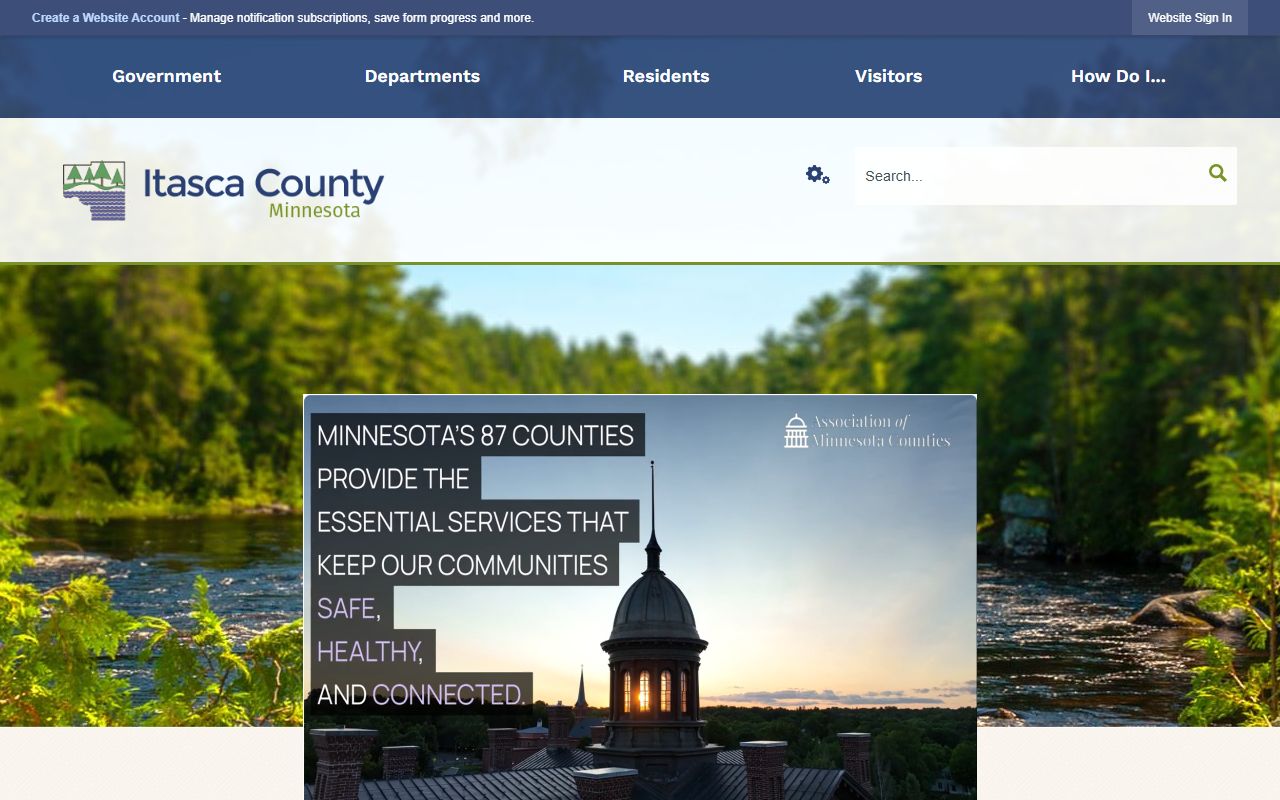
The county site is a useful starting point before visiting in person or calling to confirm hours.
How to Search Itasca County Deed Records
You have a few ways to search Itasca County deed records. The first option is the county's online property search tool, which lets you look up parcels and view recorded documents. Visit the Itasca County website and look for the Property or Land Records section. Online searches can usually be done by owner name, parcel number, or legal description.
If you prefer to search in person, the Recorder's office in Grand Rapids has terminals and staff to help you. In-person access can be useful when you need older records that may not be digitized or when you want to request certified copies. The Recorder can provide copies for a per-page fee, and certified copies cost a bit more. Bring the parcel number or owner name if you have it, so the search goes faster.
Mail requests are another option. Write to the Itasca County Recorder at 123 NE 4th St, Grand Rapids, MN, and include as much detail as you can about the property or document you need. Include a self-addressed stamped envelope and payment if copies are requested. Processing times for mail requests vary, so calling ahead to confirm the current fee and turnaround time is wise.
Minnesota deed records are public records under state law. Anyone can search them. You do not need to be the property owner or have a legal interest in a parcel to look up deed history.
Online Property Records Access in Itasca County
Itasca County offers online access to property and land records through its official website. The online system allows you to search by parcel ID, address, or owner name. Many recent deeds and property documents are available digitally. Older historical records from the late 1800s and early 1900s may only be available in person at the Recorder's office in Grand Rapids.
For statewide property data and mapping, the Minnesota Geospatial Information Office maintains a land ownership database at mngeo.state.mn.us. This is a useful tool for viewing parcel boundaries and ownership across Minnesota, including Itasca County. The map layers can help you identify neighboring parcels, locate easements, and see land classification data.
The Minnesota Department of Revenue also publishes property tax and sales data that can supplement deed searches. Their tools are at revenue.state.mn.us. Property sales records often cross-reference deed recordings and can help confirm transaction dates and amounts.
Recording Fees and Requirements for Itasca County Deed Records
The standard recording fee for a deed in Itasca County is $46. This applies to most deed types including warranty deeds and quitclaim deeds. Additional pages beyond the standard document length may add to the total. Contact the Recorder's office for the exact fee schedule, since it can change.
Minnesota deed tax applies to most real estate transfers at a rate of 0.33% of the purchase price under Minn. Stat. 287.21. The deed tax is paid at the time of recording. Some transfers are exempt, such as gifts between family members or certain government transfers, but the Recorder will need documentation of the exemption.
Before recording a deed, you must get a tax certificate from the county. This requirement comes from Minn. Stat. 272.12, which says the County Auditor must certify that all property taxes have been paid before the Recorder can accept a deed for filing. This step protects buyers and ensures the state tax system stays current.
Document formatting matters too. Minnesota sets out physical requirements for recorded documents under Minn. Stat. 507.093. These include margin sizes, font size, and paper quality. If your deed does not meet the standards, the Recorder will reject it. Most attorneys and title companies prepare deeds that comply with these rules automatically.
Types of Deed Records Filed in Itasca County
Warranty deeds are the most common deed type you will find in Itasca County records. A warranty deed transfers ownership and includes a guarantee from the seller that the title is clear of any claims. Under Minn. Stat. 507.07, Minnesota law defines what language is needed for a valid warranty or quitclaim deed.
Quitclaim deeds transfer whatever interest the grantor has in a property, with no guarantees. They are often used between family members, to clear title issues, or in divorce settlements. Because they carry no warranty, they are simpler but give the buyer less protection.
Transfer on Death Deeds, or TODDs, let a property owner name a beneficiary who will receive the property when the owner dies, without going through probate. Minn. Stat. 507.071 governs TODDs in Minnesota. They must be recorded during the owner's lifetime to be effective.
Contracts for deed are also recorded in Itasca County. Under Minn. Stat. 507.235, a contract for deed must be recorded within four months of execution. These are seller-financed purchase agreements where the buyer makes payments over time and receives the deed once the contract is paid off.
Other documents you may find in Itasca County deed records include mortgage releases, easement agreements, plat maps, and certified survey maps. Each of these affects property ownership or use and becomes part of the official land record when filed.
Property Fraud Protection in Itasca County
Property deed fraud is a growing concern across Minnesota. Criminals sometimes record fake deeds to transfer title without the owner's knowledge. Itasca County property owners can protect themselves by monitoring their records regularly.
The Minnesota Attorney General's office provides guidance on property fraud at ag.state.mn.us. If you suspect a fraudulent deed has been recorded against your property in Itasca County, contact the Recorder's office and the Attorney General right away. Acting quickly can help prevent further harm.
Checking your deed records annually is a simple step that can catch problems early. The Recorder's online search tool makes this easy. Search your name or parcel number and look for any documents you did not authorize.
Historical Deed Records in Itasca County
Itasca County has deed records going back to 1883, when the county was organized. These early records document the original land grants, homestead entries, and early property sales that shaped the county's land history. Many of these older documents are fragile and may only be available on microfilm or in bound ledger books at the Recorder's office.
For genealogy researchers and title abstractors, historical deed records in Itasca County can reveal family ownership chains, original plat information, and boundary disputes that still affect property today. The county has worked to preserve these records, though digitization of the oldest files may be incomplete.
Under Minn. Stat. 507.34, an unrecorded deed is void as to subsequent purchasers who buy without notice. This is why the recording chain matters so much. Any gap in the chain, no matter how old, can create a title defect that needs to be resolved before a sale can close.
Cities in Itasca County
Grand Rapids is the county seat and the largest city in Itasca County. No cities in Itasca County currently meet the population threshold for a dedicated city page on this site.
Nearby Counties
Itasca County borders several other Minnesota counties. Each has its own Recorder's office and property records system.