
Search Marshall County Deed Records
Marshall County deed records are maintained by the County Recorder in Warren, MN, and cover all property transfers and land transactions in this northwestern Minnesota county. A county abstracter is available, making Marshall County one of the more full-service options for title and deed research in the region. This page explains how to search deed records, what recording requires, and what services are available.
Marshall County Deed Records Overview
Marshall County Recorder's Office
The Marshall County Recorder is located at 208 E Colvin, Warren, MN. The office records all property deeds, land instruments, and public documents for Marshall County and provides public access to those records. You can find current contact information and county services through the official website at co.marshall.mn.us.
Marshall County stands out for having a county abstracter on staff. This is not common in all Minnesota counties and makes the Marshall County Recorder's office a particularly useful resource for complex title searches and formal abstract work. If you need a full abstract of title for a property, the county abstracter can prepare it, which is especially valuable in this rural, agricultural county where title work on farm land is common.
The Recorder manages both Abstract and Torrens title records. Most agricultural land in Marshall County runs under Abstract title. The county abstracter can help trace the full chain of ownership through the recorded documents. Some properties may carry Torrens certificates, and the Recorder's office can tell you which system applies to any specific parcel.
The screenshot below shows the Marshall County website, where recorder services and the county abstracter information are listed.
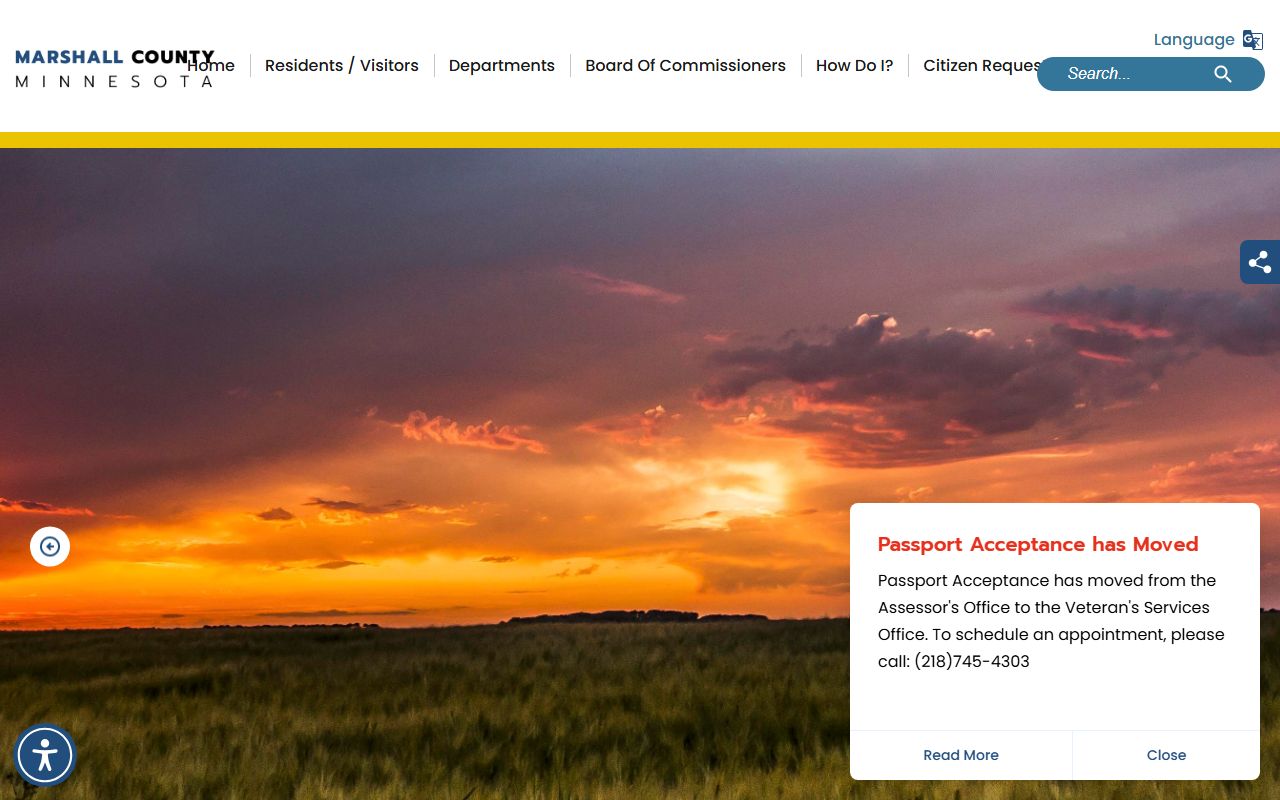
The county site is the right place to start for current contact details and to learn more about the abstract services available through the Recorder's office.
How to Search Marshall County Deed Records
Marshall County deed records can be searched at the Recorder's office in Warren in person, online if the county provides a digital search tool, or by mail. In-person searches at the courthouse give you direct access to the full document index and staff assistance. This is especially useful for complex title searches or situations where you need to look at multiple related documents.
The county abstracter can assist with formal abstract work that goes beyond a simple deed lookup. If you need a complete abstract showing the full chain of title for a property, the abstracter can prepare it. This service is particularly useful for lenders, buyers, and attorneys who need a comprehensive title history rather than just a few specific documents.
Online access to Marshall County deed records may be available through the county website. For current online search availability, check the county site or call the Recorder's office. Even when online access is available, in-person or abstracter services remain the most comprehensive option for detailed title work.
Mail requests are accepted at the Recorder's office. Send your request to 208 E Colvin, Warren, MN with a description of the property or documents you need, payment for copy fees, and a return address. Call the office first to confirm the current fees and expected turnaround time.
For statewide property mapping and ownership data, the Minnesota Geospatial Information Office at mngeo.state.mn.us provides free coverage of all Minnesota counties, including Marshall. This tool is useful for viewing parcel boundaries and basic ownership information as a complement to the deed records held at the Recorder's office.
Recording Fees and Requirements in Marshall County
The base fee to record a deed in Marshall County is $46. Documents with additional pages may cost more. Confirm the exact fee with the Recorder's office before submitting your document.
Minnesota deed tax must be paid when most deeds are recorded. The rate is 0.33% of the purchase price under Minn. Stat. 287.21. The deed tax is collected at the time of filing. Certain transfers qualify for exemptions, including gifts between close family members, transfers to a trust the grantor controls, and some government conveyances. Each exemption requires a completed form identifying the specific basis for the claim.
Before recording, the County Auditor must certify that property taxes are current. Minn. Stat. 272.12 requires this tax certificate as a prerequisite to recording in every Minnesota county. In a normal closing, the title company handles this step. If you are recording on your own, stop at the Auditor's office first to get the certificate before bringing the deed to the Recorder.
Document formatting must comply with Minn. Stat. 507.093. The required three-inch top margin, minimum font size, and paper quality standards are specified in this statute. Non-compliant documents will be returned. Most professionally prepared deed forms comply automatically with these requirements.
For homestead property, the non-titled spouse must sign under Minn. Stat. 507.02. This spousal signature requirement applies to any deed that conveys or encumbers the homestead. Failing to get the required signature creates a title defect that can be costly to resolve later.
Deed Types in Marshall County Records
Warranty deeds are the most common deed type in Marshall County's recorded documents. They transfer title with full guarantees from the seller. Minnesota law at Minn. Stat. 507.07 defines the language required for a valid warranty deed. Buyers purchasing agricultural or residential property from an unrelated seller in Marshall County should expect to receive a warranty deed.
Quitclaim deeds transfer ownership without any guarantee. They are frequently used for estate distributions, family property transfers, and clearing title defects. In Marshall County, quitclaims often appear when farm land passes from one generation to the next within a family. They are simpler and cheaper to prepare than warranty deeds but carry more risk for the buyer.
Transfer on Death Deeds provide a way to pass property to a beneficiary at death without probate. Minn. Stat. 507.071 governs Minnesota TODDs. The deed must be recorded during the owner's lifetime and can be revoked at any time before death. For farm families in Marshall County looking to pass agricultural land to children without the expense of probate, TODDs are a practical option.
Contracts for deed appear regularly in Marshall County records, particularly for farm parcels. Under Minn. Stat. 507.235, a contract for deed must be recorded within four months of signing. Recording protects the buyer's interest and puts third parties on notice of the agreement. An unrecorded contract leaves the buyer exposed to competing claims.
Torrens Title Records in Marshall County
Some properties in Marshall County carry Torrens title, which is a court-registered system governed by Minn. Stat. Chapter 508. Under the Torrens system, ownership is recorded on a certificate of title issued by the court. Transfers of Torrens property are handled differently from Abstract property, and the Recorder's office maintains the certificate of title for registered land.
If you are researching a Torrens property in Marshall County, the search process starts with the certificate of title rather than a deed chain. The Recorder can pull the certificate and show you the current registered owner and any encumbrances listed on the certificate. The Minnesota Courts website at mncourts.gov also maintains records related to Torrens registrations, since the initial registration involves a court proceeding.
Torrens property carries stronger title protection in some ways because ownership is backed by a court-issued certificate. However, the process for making changes to a Torrens certificate can be more involved than simply recording a new deed. If you are buying or financing a Torrens property in Marshall County, working with a title professional who is familiar with the system is advisable.
Property Protection and Fraud Prevention in Marshall County
Property owners in Marshall County should check their deed records periodically using the county's online system or at the Recorder's office. Deed fraud, while less common in rural counties, is still a risk. Search your name and parcel number and look for any unexpected filings.
If you find a suspicious document, contact the Recorder's office and the Minnesota Attorney General at ag.state.mn.us. Under Minn. Stat. 507.34, an unrecorded deed is void against subsequent purchasers who pay value without notice. Recording your deed promptly after any transaction is one of the most effective protections available.
Historical Deed Records in Marshall County
Marshall County has a long land record history reflecting the agricultural settlement of the Red River Valley region in northwestern Minnesota. Early deed records document the original land grants, homestead entries, and farm sales that established property ownership patterns across the county. For title work on older properties, the chain of title can run through many generations of farm families who held the same land for decades.
The county abstracter at the Recorder's office is a particularly valuable resource for historical title research. A formal abstract prepared by the county abstracter traces the full chain of recorded documents from the original grant to the present. This kind of comprehensive review is what lenders and title insurers rely on when evaluating title risk on older properties.
Older records at the Recorder's office may be in bound ledger books or microfilm for the earliest time periods. The digital system covers recent decades well, but for historical research going back to the late 1800s or early 1900s, the physical files at the courthouse in Warren remain the primary source.
Cities in Marshall County
Warren is the county seat and largest city in Marshall County. No cities in Marshall County currently meet the population threshold for a dedicated city page on this site.
Nearby Counties
Marshall County is in northwestern Minnesota, sharing the Canadian border to the north and bordering several other Minnesota counties.